Discovering the safety risks of pivot pin maintenance in mining
The serious risk traditional pins pose as workplace hazards in mine operations underscores the benefits of the Expander® System.
Pivot pins are critical to almost any mining operation. The often-underappreciated component may seem insignificant, but it’s a key mechanism in heavy machinery, from haul trucks and dozers to rope shovels and excavators. And keeping those machines reliable is a major operational and business imperative for mines.
“Efficient and predictable pivot maintenance is not just a mechanical necessity. It's a core business requirement for maintaining operational throughput,” says Paul Yoong, Sales Manager for Expander in the Asia-Pacific region.
Based in Australia, Yoong’s role has required him to work closely with mine operators and maintenance teams implementing the Expander System. It’s given him insight into how pivot pin maintenance can impact a mining operation – in terms of repair costs, lost production time, and workplace accidents.
“The safety risks associated with traditional pivot pin maintenance are significant and, in some cases, quite severe,” says Yoong.
“The deep-seated, systemic safety flaw of a design that is prone to seizing”
There are numerous accident reports compiled by mining regulatory agencies that illustrate how dangerous pivot pin maintenance can be – particularly when a traditional pin design seizes and has to be removed.
In 2019, a worker on a team trying to remove a seized pivot pin from a haul truck at an open-cut mine in New South Wales, Australia, was struck by the nearly 50-kilogram pin when it was suddenly ejected. According to the official causal investigation report of the incident, the worker was injured while thermal-lancing the pin – a common practice in which the pin is pierced with extreme heat and then rapidly cooled with water to reduce its outer diameter. In this case, a high amount of steam was also created and propelled the pin into the worker – cracking his hip, fracturing a thumb, and causing minor facial and eye injuries.
“The most common risks revolve around the extreme forces and methods required to remove traditional pins that are seized,” says Yoong. “The danger here wasn't that they were being careless, but that the risk of the method itself wasn't fully controlled.”
Such methods often result in so-called “struck-by injuries” – from pins, heavy tools, or lancing slag. Many stories like the one from 2019 in New South Wales can be found in the Mine Safety and Health Administration (MSHA) data on non-fatal accidents and injuries in the United States. And similar accidents can ensue from attempts to remove pins using hydraulic tools as well. In early 2012, according to the MSHA dataset, a maintenance worker at a quarry in Kentucky was trying to remove a seized pin in a lift cylinder when the hydraulic pressure caused the pin to shoot out and strike him so hard that his safety glasses left a laceration just under his left eyebrow.
Burns and eye injuries can also occur during thermal lancing or other welding activities in pivot pin maintenance. In 2006, the US state of Virginia’s agency that regulates its mining published a safety alert detailing an accident from January of that year, in which a contractor using a burning bar on a pin in an excavator hit the excavator's grease reservoir. The contractor was hospitalized with first and second-degree burns from the resulting back flash.
These and many other recorded maintenance accidents highlight that most in the mining industry only become aware of the safety risks in pivot pin maintenance after an accident or near-miss.
“While the symptoms are understood, the deep-seated, systemic safety flaw of a design that is prone to seizing is often not fully appreciated until an incident,” says Yoong, who stresses that it isn't just about procedures of pivot pin maintenance but also the pin itself. “The danger is engineered into the traditional pin design, which is virtually guaranteed to seize and fail over time.”
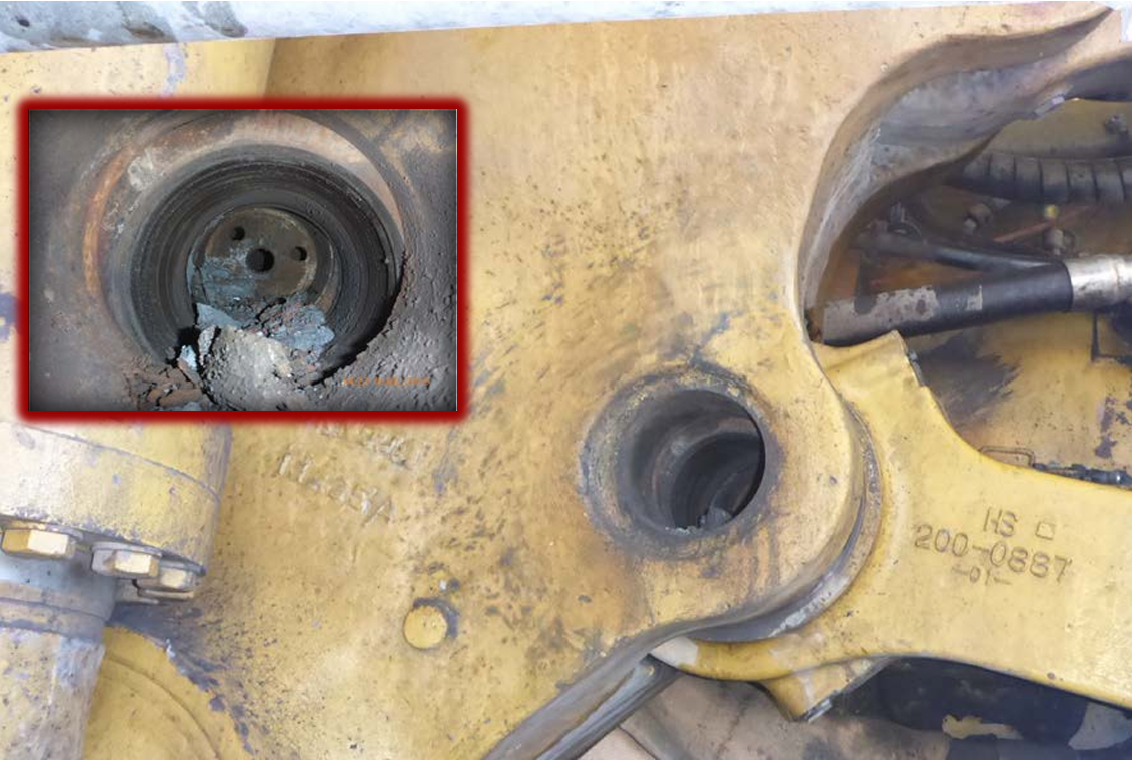 Image from NSW Resources Regulator - Pin ejection incident report.
A fundamental shift in safety
According to Yoong, mine operators are initially drawn to Expander as an aftermarket pivot pin replacement in their heavy-duty machines because its fast, simple installation and removal greatly reduce machine downtime. After a while, however, they develop an appreciation for its safety benefits.
“The Expander System is safer because it’s designed to eliminate the root cause of the most dangerous maintenance activities,” says Yoong.
Wear-resistant, Expander’s pivot pin solution uses tapered ends and expanding sleeves to remove play, reduce friction, and eliminate micromovement. High angle taper and vented sleeves reduce the seizing risk and in case of lancing pressure build up risk. And because the Expander’s sleeves conform to fit worn lug bores, they not only prevent further lug wear but also remove the need for welding or line boring.
Those features of the underlying technology can help make a mining operation safer through more predictable maintenance of its heavy machinery.
“The Expander System represents a fundamental shift from managing the hazards of pin maintenance to eliminating them at the source,” says Yoong. “The safest pivot pin is the one you never have to fight, cut, or fear.”