
Managing Risk in Brownfield Projects: How Micro Interventions Complement Traditional Shutdown Work
By Ifeanyi Okpala, Ph.D. PMP
In live oil and gas facilities, maintaining safe and compliant operations while executing maintenance or modification work is a constant challenge. Brownfield projects involve existing operating assets with legacy equipment, aging materials, and historical modifications that may not be fully documented. These environments require engineers to balance technical risk, regulatory compliance, and production continuity. Historically, large shutdown campaigns have been used to manage this complexity. Entire units are taken offline so inspection, maintenance, and capital work can be executed in a single window. While this approach remains necessary in certain circumstances, industry data shows that large shutdowns in brownfield environments frequently carry elevated risk and uncertain outcomes.
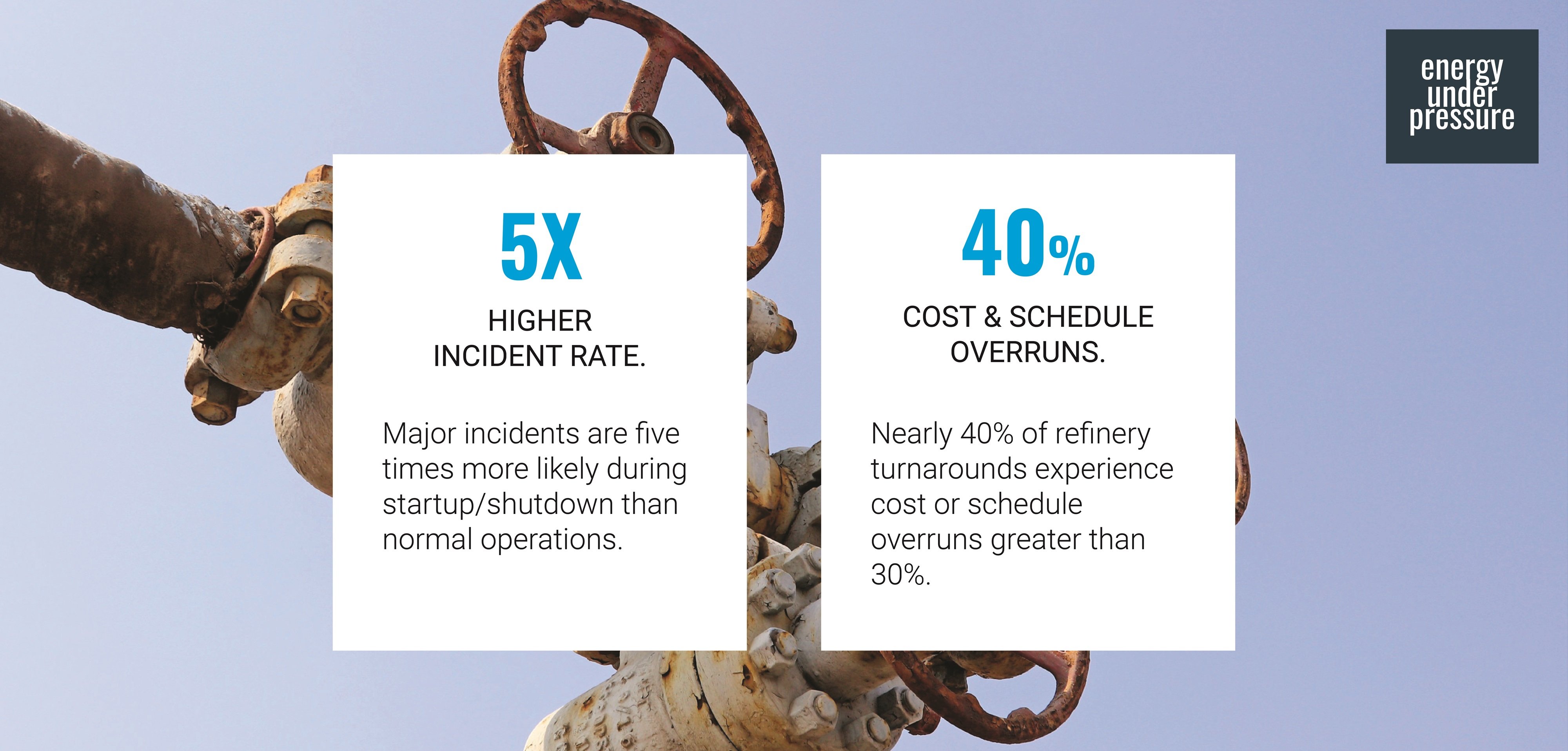
Turnaround benchmarking published by Asset Performance Networks indicates that more than two-thirds of major refinery turnarounds finish late or exceed budget. Nearly 40% experience cost or schedule overruns greater than 30%. Safety data from the Center for Chemical Process Safety indicates that process safety incidents occur approximately five times more frequently during startup than during normal operations. In addition, refining industry studies have shown that roughly half of serious process incidents occur during startups, shutdowns, or other infrequent operating modes, despite these modes representing a small portion of total operating time.
Although these findings are not enough to eliminate shutdowns completely, they highlight the need for alternative execution models that reduce cumulative exposure while maintaining regulatory and safety standards.
Why Large Shutdowns Struggle in Brownfield Environments
Large shutdowns in brownfield sites face challenges that are structural in nature.
Scope Growth Driven by Latent Conditions
Existing assets often contain corrosion, undocumented repairs, or degradation that is not visible until equipment is opened. Industry databases indicate that the average turnaround scope grows by nearly 20% between planning and execution. Each additional scope item increases labor, material, and schedule exposure.
Interface Risk
New mechanical, structural, or control system elements must connect with existing infrastructure that may differ from design records. Misalignment, load redistribution, and signal compatibility issues often emerge during execution, when corrective changes are most disruptive.
Simultaneous Operations (SIMOPS) Congestion
Major shutdowns can involve thousands of temporary workers from multiple contractors operating in parallel. While individual tasks may be assessed as safe, overlapping activities introduce interaction risks that are difficult to model fully. Regulatory guidance on SIMOPS consistently identifies coordination failures as a leading contributor to incidents during turnarounds.
Asset Response to Shutdown and Restart
Aging equipment may tolerate steady operation but respond unpredictably to cooling, depressurization, disassembly, and reactivation. Thermal stress, seal degradation, and material movement can extend outage duration or affect post-restart reliability. These factors explain why large shutdowns frequently experience cost escalation, schedule uncertainty, and elevated safety management complexity.
The Micro Intervention Philosophy
Micro intervention is a narrowly defined task executed in a short window, commonly lasting between two and eight hours. Each task is engineered to limit the extent of isolation, exposure, and interface with live operations. Only the minimum necessary portion of the system is affected. Micro interventions should be seen as a complementary execution model rather than a universal replacement for shutdowns.
This approach reduces cumulative exposure by limiting the number of simultaneous activities.
- Crews focus on a single task.
- Energy isolation boundaries are simpler and easier to verify.
- Operational oversight remains continuous because much of the facility stays in service.
Micro interventions also provide scheduling flexibility.
- Tasks can be aligned with production constraints, redundancy availability, and regulatory inspection requirements.
- If unforeseen conditions arise, the impact is generally limited to that specific intervention rather than an entire outage.
Micro interventions are selected based on risk assessment.
- Not all work is suitable for execution in this manner.
- Site-specific criteria must always govern applicability.
Technologies Commonly Used in Micro Interventions
Mechanical fasteners remain vulnerable points in high-vibration environments. Advanced fastening solutions such as wedge-locking washers and Superbolt tensioners, which are engineered to resist loosening under extreme vibration, are being increasingly deployed across Oil & Gas and Power Generation facilities.
Localized isolation technologies allow targeted sections of piping or equipment to be isolated without depressurizing entire units. Industry case studies report that freeze plug or mechanical line isolation methods can reduce preparation time by seventy five percent or more compared to conventional drain and purge approaches, subject to fluid composition, temperature, and pipe condition.
Temporary load bearing structures provide stability during component removal or replacement. Engineered supports, jacks, and frames are used to control load paths and prevent unintended movement during work. These systems must be designed and reviewed by qualified engineers based on site conditions.
Portable monitoring technologies provide real time visibility during execution. Wireless vibration, strain, pressure, and temperature sensors can be deployed quickly and removed after use. The declining cost of industrial sensors has enabled short term monitoring without permanent installation, supporting informed decision-making during work and restart.
Modern fastening and tensioning systems reduce time required to open and reassemble mechanical joints while improving preload consistency. Industry experience indicates that these systems can significantly reduce bolting duration compared to traditional methods, while supporting joint integrity when applied in accordance with manufacturer guidance and site procedures.

Engineering Workflow for Micro Interventions
Focused Risk MappingMicro interventions rely on rigorous engineering discipline. Each intervention begins with focused risk mapping involving engineering, operations, and safety representatives. Energy sources, interfaces, and SIMOPS interactions are identified. Control measures are defined and documented before execution.
Isolation and StabilizationEnergy sources are physically verified, and temporary supports or monitoring systems are installed before critical work begins. Isolation methods are selected based on regulatory requirements and site standards.
Real-time MonitoringDuring execution, real-time monitoring supports situational awareness. Live data enables early detection of abnormal conditions and supports conservative decision-making. Work proceeds according to approved procedures with defined hold points.
System RestorationFollowing completion, systems are restored in a controlled manner. Verification checks are performed, temporary systems are removed, and documentation is completed before return to normal operation.
A practical example is one in which a crew had a side branch valve that was starting to seep. It was getting harder to operate. It was not an emergency but it was not something you want to carry for months. Waiting for the next turnaround meant living with the risk and the operating headaches. Operations agreed to give the team a controlled 4-to-6-hour window on a low demand period, with nearby work restricted and no appetite to depressurize adjacent equipment.
Before the shift, the engineer, the operator and foreman walked the line together and agreed on exactly what could go wrong and what would make them stop. They traced every path that could feed the branch and checked what else in the area could conflict with the job. Next, the isolation method was selected to only block the small segment needed for the swap while the proof steps were written down so there was no guessing in the field. The valve, gasket, studs, nuts and tools were staged at the work face while the crew checked orientation and clearances one more time.
On D-day, the first milestone was proving isolation independently before any bolts were loosened. Next, the valve came out allowing the team to clean and inspect the flange faces. The joint went back together using the approved tightening sequence with a quick verification of bolt load where required. Repressurization was done while the crew watched for leaks and operations monitored trends. After the joint stayed dry and the system settled, the temporary items were removed. The team captured lessons learned while the details were still fresh.
Impact on Asset Integrity and Uptime
When applied appropriately, micro interventions can reduce exposure associated with full shutdown cycles. Smaller interventions limit thermal and mechanical transients by keeping equipment closer to steady operating conditions. Reduced frequency of full unit shutdowns can lower cumulative startup related risk, consistent with industry safety data. Temporary supports help stabilize aging structures during repairs, reducing the likelihood of unintended load transfer. Controlled fastening methods support joint reliability following reassembly.
From an operational perspective, production impact is distributed across short, predictable windows rather than concentrated into extended outages. Industry analyses indicate that refinery downtime can represent up to $50 million dollars in lost margin for a midsize facility, depending on market conditions. Avoiding unnecessary outage duration has measurable financial implications. Improved reliability also supports resilience during market or supply disruptions, where facilities that remain operational may capture incremental value relative to peers.
Optimizing For the Future
Brownfield projects will always involve uncertainty, but the distinction lies in how that uncertainty is managed. Micro interventions acknowledge the realities of live operating sites and apply modular execution to reduce cumulative risk while maintaining compliance with safety and regulatory requirements. When supported by appropriate engineering, technology, and governance, this approach can complement traditional shutdown strategies.
Sources and Disclaimer: This article references publicly available industry data and guidance, including publications from the US Chemical Safety Board, the Center for Chemical Process Safety, Asset Performance Networks, and published case studies on live isolation, condition monitoring, and maintenance reliability. All examples and data points are illustrative and generalized. Actual results depend on site-specific conditions, regulatory requirements, asset conditions, and execution quality. This article does not replace formal engineering analysis, safety review, or regulatory compliance obligations. All work must be planned and executed in accordance with applicable laws, standards, and company procedures.