A Nord-Lock connection in support of certified training for bolting engineers
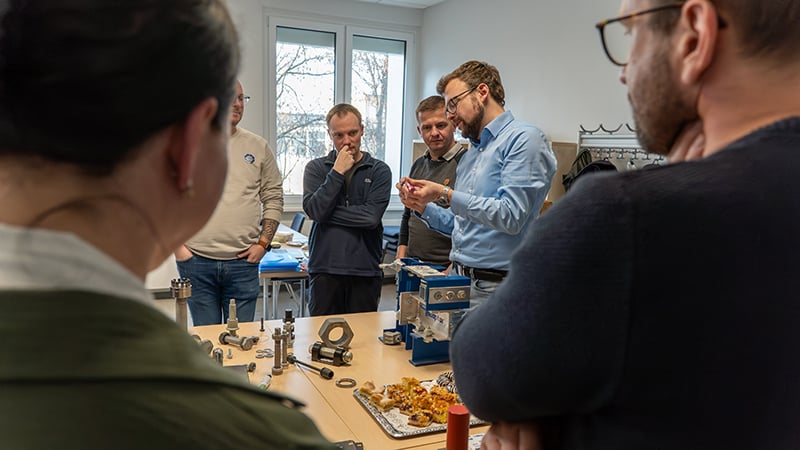
In October of 2025, TÜV SÜD Industry Service in Dresden launched the first part of a course unlike any other: the inaugural class of its International Bolting Engineer (IBE) program. This new multi‑stage training features in‑depth lectures and hands‑on workshops focused on bolted technology and is poised to become a globally recognized industry certification.
 © TÜV Süd
In October of 2025, TÜV SÜD Industry Service in Dresden launched the first part of a course unlike any other: the inaugural class of its International Bolting Engineer (IBE) program. This new multi‑stage training features in‑depth lectures and hands‑on workshops focused on bolted technology and is poised to become a globally recognized industry certification.
Frank Götz, Business Development Manager for Construction at Nord-Lock Group, was an instructor during the first two days of classes and helped develop the IBE program’s curriculum. He says globally certified training for working with bolted connections is long overdue, pointing out that similar certifications and qualifications for techniques like welding have been recognized around the world for years.
“There is somehow the mindset that everyone can tighten a bolted connection because it's just using the wrench and tightening the bolt,” explains Götz. “And that leads to problems, especially when it comes to critical joints, like in industrial settings or for bridges and railroads.”
A gap in bolted-joint expertise
According to Götz, TÜV SÜD is an ideal organization to create and launch the IBE program. As one of the leading global companies in this area, it provides independent training, inspection, and certification services through its more than 1,000 locations for a variety of industries.
So, when TÜV SÜD approached him about joining the IBE development team in early 2025, Götz agreed. He’d seen a real need for such training in his role at Nord-Lock, where he regularly meets with customers seeking bolted solutions and some struggle to prevent the underlying causes.
 © TÜV Süd
“There are many different factors that can affect a bolted connection and cause it to fail,” Götz explains, “Sometimes it's about the wrong design of the joint. And even if the joint is designed properly, then there is a mistakes made during tightening, surface preparation or even the choice of fastener itself.”
It was that type of real‑world experience that proved essential to helping the IBE program development team shape the program’s structure and curriculum through a series of workshops over approximately six months. As outlined on the IBE page on TÜV SÜD's website, the program is organized into basic and advanced modules. The basic module explains topics like preload force, torque, friction, materials, tightening methods and tools over seven days – which were split for the first class across late October and early December 2025. Each of the advanced modules has a specific industry focus: steel construction, flange connections, and railway vehicles. Participants can take the advanced modules individually or as a complete series, depending on their needs.
From local launch to global reach
Materials promoting the IBE program highlight a focus on practical applications with equal time spent on hands-on learning. Götz estimates that the course is roughly 50/50 in terms of theory and practice and is particularly helpful for engineers and technicians designing and implementing bolted joints.
“The participants gain a clear understanding of the many factors that influence a bolted connection – and where the limits lie. Just as importantly, they will learn how to positively influence those factors through proper design and execution,” he says.
Although the program is currently offered in German, TÜV SÜD is exploring the possibility of providing an English version in the future. The structure of the program is also being reviewed to combine theory and practice in a blended format, where selected parts could be completed online while the essential hands‑on training would take place on‑site in Germany over just a few days.
Interested participants can already register their interest via the website. Once the dates for the English-language training have been confirmed, they will receive an invitation to enroll.